Monday, April 25, 2016

"It's Floodin' Down in Texas..."

So opens the lines to the "Texas Flood", a song written by Larry Davis in 1958 and made really famous by Stevie Ray Vaughan some 25 years later (you can watch a live performance here).

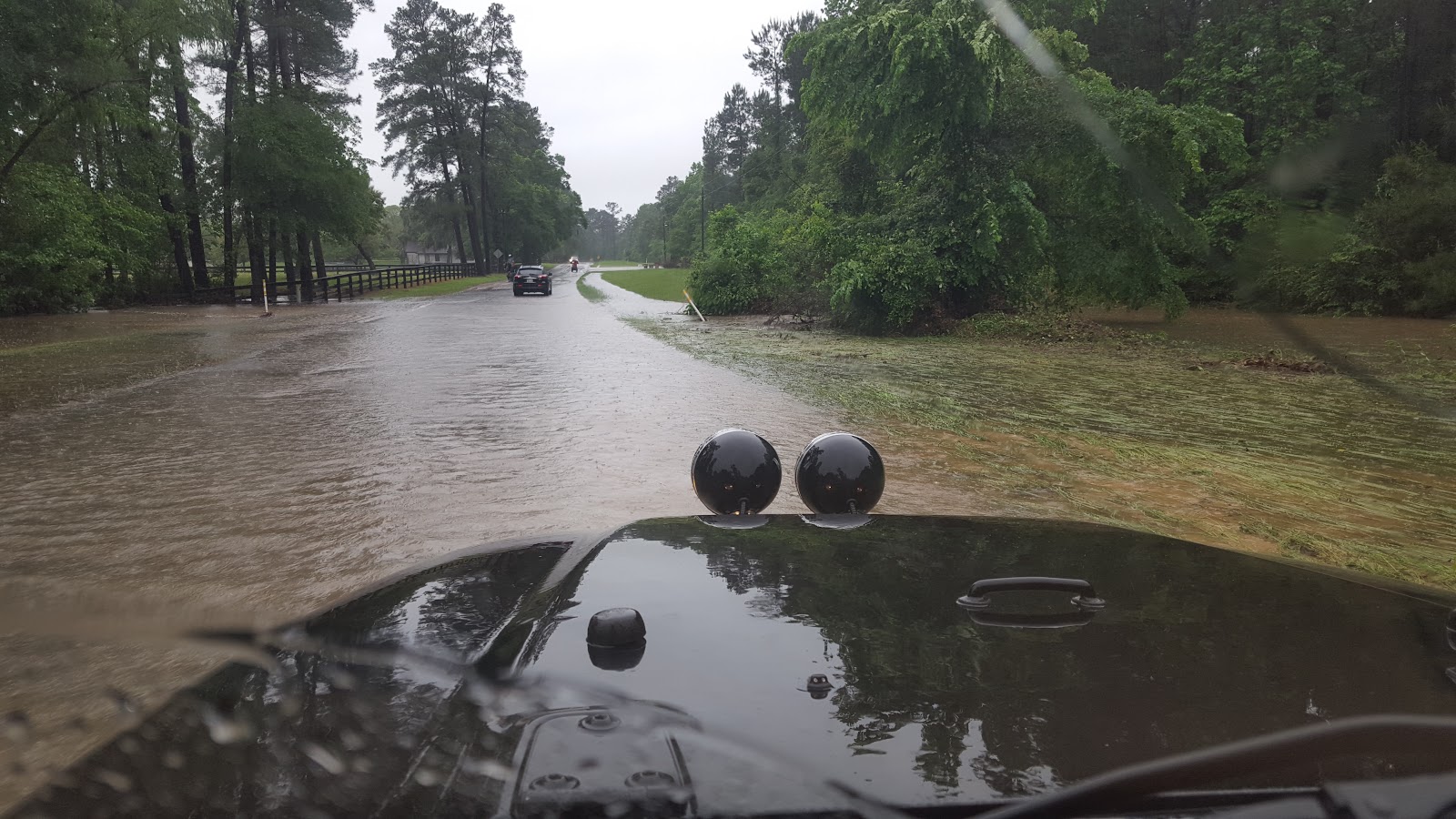
We endured the flooding, losing Pam's car about 100 yards (~ 100 m) from the safety of our neighborhood's gate.  It stalled in high water, and I got out of the car, waded to the gate, ran about a quarter of a mile (400 m) to get my Jeep, then drove back to retrieve Pam, my mom, and Mom's luggage (we were on our way back from picking her up at the airport).  All of this occurred about 1 AM.  We are all safe and well.  The house had no flooding, and our rain runoff pathed as we had hoped.  We were also blessed in that we lost no trees, at least none in the immediate perimeter of the house.

Just for an example of scale, the 20 inches (50 cm) of rain which fell on our five-acre (two-hectare) property can be expressed as 2,715,439 gallons (10,279,055 liters) of water.

Here is a video recorded two days later, after the torrential pouring had stopped (video link):


The entire drainage ditch was widened at least 50% by the fast moving waters.   The next day after the above video was recorded, we had heavy rains again (video link):


We now need to have a new hardscape plan to prevent further erosion of our drainage ditch, which will include four-inch (10 cm) thick flagstone and bullrock.  It might include the building of a retaining wall where the ditch bends around the front of the house and heads downhill.

Here are additional pictures from this "Texas Flood":

Pam's car, the next morning.  The water receded considerably, as the the night
before the water was up to the bottom of her headlights.

We had gotten through the worst part when the car died.  This is along the
drainage creek path -- the creek which actually (and ironically) runs along the
rear border of our property.  It had overflowed its banks and was over my
ankle-bone as I took this picture.  It was knee-high hours earlier when we
stranded the car.

I drove through the ankle-deep water in the Jeep to take this picture of the
water and Pam's car.  The Jeep, with no modifications, can traverse 30 inches
 (~80cm) of water.  Had we known it was going to flood like this, I would have
put the rear seat in the Jeep and we would have used it to go to the airport.

This is taken from our street, which is about 10 feet (3 m) above the
foundation of the house.  The leaning oak after which we have named our
home can be seen in the foreground. 

The water drains from the large pipeline right-of-way which runs across the
front of our property through the trees at this point, which is to the left
of the property in the picture above, in front of the two-car garage (the
structure on the far left).  Here we will add flagstone to slow the water's
velocity before it hits our drainage ditch.

This is the bend to which I referred above, and it is at least 100% wider than
it was the day before the rains.  I will probably build a retaining wall, as another
heavy rain could cause the tree to fall.

This is the way it is supposed to work, with the water draining around the
foundation pad and running downhill to the creek.  This part worked well.

Our deer returned to feed again, and paused long enough for me to take his
picture before entering the thicket.

The wildflowers remind us that there is life after the storm.  These have seen many, and continue to return and bless us
with their beauty.  These grow in the front of our property.

Wednesday, April 6, 2016

Terra, Flora, and a Salad (but not necessarily in that order)

The lawn continues to thicken in places, and in other places, it is trying to take hold.  Leveling is still a challenge, and over-seeding is still taking place.  Raking rocks has become the "dread-but-must-do" task, and the simple pleasure of mowing yet abides.

Low angles are good for viewing many of my lawn areas now, because it is the only way it looks like we have real turf.  Don't get me wrong, it is coming along, but not fast enough for me.  It is coming along at the right rate, mind you, I just want to see quicker results.  That's why pictures in time-lapse are good; they remind me it is all progressing as expected.

I still have some low spots in the front which I need to level in order to improve drainage.  The last major leveling effort was effective, but I knew it would need to be tweaked.  I watered the lawn until it was soaked and could see the low areas in need of filling.  I need to remember to fluff the existing grass through the fill-soil so that it does not get smothered.

I rake the flanks of the property for rocks now, using my three-foot (0.9 m) landscaping rake.  Rocks occupy soil in a manner such they grass cannot grow it.  Rocks facilitate erosion scarps.  Rocks retain heat and dry the soil around them.  Rocks and grass do not play well together.  All along both sides of our 150-foot+ driveway, I have rocks seeping through from the days of construction.  With every rain there is a new rock reveal.  The only effective means of removing them is raking with the landscape rack.  I have tried others, but the landscape rake is the most efficient.  I will be raking well into the month of May.

The landscaped plants are in bloom, or very near to blooming!  The native flora is coming along well, also, with a few surprises (next blog).  I have pictures from African Iris, Red Yucca, and our Dogwood trees on this post.  We have lost about half of our prostrate rosemary, and our landscaper will replace it.  We do not know what problem the plants experienced.

Mowing is still the easiest and most satisfying aspect of my lawn care -- at this point.  I do the raking, edging, weed-whacking, trail maintenance, debris-blowing, adjusting sprinklers and their heads, and mowing.  Mowing feels like a reward after I have done the other stuff.

And I did not forget about the salad (see below)...

Enjoy the pictures:

One of my trouble areas in the front, still holding water hours after 16 minutes
of irrigation.  This needs to be resolved by filling and leveling.

Same area, different perspective using the sun to illuminate the standing
water.  When filling and leveling, I must take care that I do not damage the
existing grass.

Surprise!  This is a new project: growing native grasses in four-inch (10 cm)
pots.  I have Pink Muhly, Mexican Feathergrass, Little Bluestem, Blue Grama,
and Texoka Buffalograss.  I want to start them and then place them in different
areas between the house and the "wild" areas.

Here is a picture of the landscaping in the front of the house.  There is still
more to add, but in general, what is here is growing well.

The Red Yucca is coming along beautifully.

Our African Iris flowers are blooming in greater numbers now.

When will the Dogwoods bloom?  Can we be any closer?  The warm temperatures
and sunny days which loom ahead could pop the blossoms!

A Leaning Oak salad -- a meal unto itself.  I got into making "meal salads"
while I was in France, but this is the first one I have made at Leaning Oak.
It contains a "spring blend" of greens, walnuts, pine nuts, green olives,
tomato, carrots, dried cranberries, Italian salami and coppa, Serrano ham,
and topped with O2B2: Olive Oil , Balsamic Blanc (White Balsamic
Vinegar), and a dash of sea salt.  Enjoyed on the lanai.


Monday, March 21, 2016

Landscaping, Three Weeks Later...

I could not believe it had been three weeks since I posted!  What is wrong with me?  Oh yeah, I've been busy with nurturing the landscaping, among other things.

I looked at my American Express (AX) bill from the last month, which includes the last three weeks.  To be sure, Home Depot, Lowe's, and Tractor Supply Company have all benefitted from the landscaping effort at Leaning Oak.  Tools, hoses and other related kit, topsoil, and a new mower all put a sizeable ding in the AX bill.  I will say; however, that the new mower was among the smallest items purchased.  I originally thought I would a big Toro Zero Turn Radius (ZTR) mower for this property, with all the trees and other odd challenges it presents.  The one I wanted is here, but upon examining the places where I actually have grass, I realized the ZTR was overkill.  I got this mower, instead.  Yes, an old-style, reel-cut mower.  

A reel-cut mower acts like scissors when cutting the grass instead of a machete, as rotary mowers do.  I can cut the entire lawn in less than an hour without extra effort.  My mower came with a grass catcher, but I have yet to use it.  I have been mowing very frequently to encourage grass density development -- this is what golf course managers do to insure a tight turf on golf courses, and it works the same for any turfgrass.  As our lawn areas have been seeded, turf density must be stimulated by mowing.  The reel-cut mower I have can cut from 1-inch (2.54 cm) to 3-inches (7.62 cm).  I was cutting some areas almost daily at 1 1/8-inch (2.86 cm).  Because of the scissors-like cut, where the grass blades are cut between a blade's sharp edge and the bedding knife, very small cuts can be achieved.

Side note: I had a self-propelled powered seven-blade reel-cut mower, very similar to the ones used on putting greens at golf courses when we lived in Oklahoma 25 years ago.  Because of the grass type and the mower, it was easily the most beautiful lawn I ever had, and yes, it was almost like a putting green.

The pictures today show some progress on our turf development, with pictures contrasting where we are now versus where we were three weeks ago.  We are still have a long way from having a lush lawn (in the manicured areas immediately adjacent to the house, the rest is still being left wild, but more on that in a near-future post), but we are getting there.  The grass which you see is still the cool weather perennial ryegrass, as the temperatures are not yet warm enough for the bermudagrass to emerge.

Here are the pictures, beginning with the "perspective" shot taken yesterday:

Taken yesterday, late afternoon...

Taken three weeks ago...

Taken yesterday

Three weeks ago...

Yesterday

Three weeks ago...

Yesterday.

The area in front of the two-car garage looking toward the street.  This area
did not receive the hydro-mulching (we ran out) and was seeded by hand.  It
also holds water (it does not always drain well), and getting the seed to
establish has been a challenge.

The same area, looking toward the two-car garage shows the gravel trim (to
keep cars off the grass) and the dogwood trees, which are now in leaf.  Blooms
are coming soon.

Yesterday, taken around mid-day, another perspective on the house and lawn development.


Tuesday, March 1, 2016

Landscaping is slowly coming around...

Landscaping is a slow process.  One cannot construct a tree in a day or two, nor have lush and inviting flowerbeds thriving in a week.  Of course, you could transplant those things in a day; but being growing and vibrant?  That takes time.  Today's pictures are a snapshot in time, if you will.  They are about the landscaping effort taking shape: some by our hand, and some by nature.  Just a heads-up: I have not yet seen the first of the wildflowers, but it is very early in the season for them.

Here are pictures and their stories:

We have created a problem for some of the birds.  We noticed this bluebird
after we heard a loud THUNK on the window.  He was laying on his side
for several minutes, then righted himself, eventually flying away.  It has been
years since I have seen a real bluebird, and it is nice to know they are a part
of our property and now our lives.

We love rocking chairs.  We have wanted rocking chairs for the front porch
since it was first conceived.  What we could not do was decide which ones
to get.  Our first thought was that we should get rockers from Cracker Barrel;
who has not enjoyed those rockers?  Yet, look at the wear and tear on the
rocker elements due to the concrete  They would not last very long.  We looked
at various plastics, including POLYWOOD, which is quite pricey.  We settled on
the Riata III collection found at H.E.B grocery stores: cast-aluminum and powder-
coated paint.  These are not only comfortable, but should last a very long time.

In the ongoing combat against mud and soft soils, we added this flagstone
path to the rear of the house.  It was the first one that i have ever done, and
required about 2500 pounds of stone (~1100 kg).  I got help at the end
(shown above) from my daughter and son-in-law as I was pretty tired by then.

The flagstone path connects the lanai and the back porch which is off the
utility room, and enables access to plants and sprinkler heads along the way.

Soon our new dogwood trees will be in bloom!  This is a good sign of health,
as all three of them are making their way toward blossoming.

The loropetalum is flowering nicely in the front beds.

Some of the grass seed has taken, and it looks like we might have a lawn after
all.  The grass which is seen here is the rye grass, an annual grass which will
give way to the Bermuda grass as the temperatures rise.  None of the Bermuda
grass has appeared, nor the fescue we sowed in the back.

The perspective shot showing grass along the drive, the side of the house, and grass in front of the two-car garage (far
left center of the photo).  I am ready for the oaks to begin leafing...

Monday, February 29, 2016

Weathering the storm

Remember the aggravation I expressed over the delay in the hydro-mulch people shifting their Monday arrival to Friday (then showed up on Thursday)?  Oh?  You didn't.  Oh yeah, I spared you of that post.  We could have used the extra days they took from us.  A couple of days after the hydro-mulching, a storm blew into our area with intense rainfall (over two inches, five centimeters) and winds up to 40 mph (65 kph).  The landscaping blanket was blown off the slope of the main house, and a lot of the hydro-mulch effort is now somewhere in our forest.  The days we lost for "whatever" reason would have cut our losses significantly.

The pictures on this post give illustration of the impact of the storm.  Referring back to the previous post and comparing the pictures will illustrate our concerns about the loss of seed.  I have since purchased Bermuda Grass seed (25 pounds for $130! (12 kg for 120 euros)).  The coverage for such a bag is 10,000 square feet (~930 square meters).   Though a lot for that kind of coverage, it is less than 10% of the cost of hydro-mulching (though hydro-mulching also includes rye grass seed with the Bermuda seed, and is supposed to be more effective in establishing a lawn).   I could not afford to do the hydro-mulching twice, and as there are a lot of slopes and uneven ground (another place of excelling for hydro-mulching), I got out my hand broadcast spreader and seeded the entire yard.  I even threw some wildflower seeds in certain areas for good measure.

Here are the pictures:

This is the back 'platform', and the land mine-sized divots are places
where the ground gave way on me.  I had been walking on this area
for several days without a problem, but when the rains came, we
discovered how soft the built-up areas around the house really are.

The landscape blanket got blown off the slope, and took a lot of grass seed
with it.  One can see the rye grass poking through the places where the
blanket remained intact.  As the main purpose of the grass is erosion,
we are starting over in this area.  I will be bringing native grasses into play.

The natural drainage of the driveway/motor court comes right at the basketball
goal, and this storm incised a definitive cut into the slope behind the goal.

Another example of erosion off the slopes, this one caused by the drain pipe
we installed as part of our rain run-off management.  We will permit the erosion
for at least one more rain, then we will fill the incisions with landscape fabric
and rocks.  This will slow the velocity of the water and prevent further erosion.

It was green with the hydro-mulch stain before, but has now been re-seeded.

The rapid pouring of rain also eroded our edging before it could get established.
This will be filled-in again and compacted.  The grey you see in this picture
is from the wildflower seed which I sowed, and if you zoom on a large screen,
one can see the much smaller Bermuda seed as well.

Thursday, February 18, 2016

Landscaping, Phase I, is now complete.

The hydro-mulch service team gave us a surprise visit this late afternoon (instead of tomorrow), and they completed the job by dusk.  This marks the close of Phase I for landscaping.  The crew will be here tomorrow to complete tweaks and cleanup, but no further additions will be made at this time (except for the already-paid-for blue lantana and Mexican Feather Grass, when suitable plants become available).

I have already begun my own Phase 1, which involves some tree-trimming, tree-removal, and removal of "undesirables" (defined as Chinese Privet and briar vines, for the most part).  I am also in the process of identifying saplings for harvest and protecting their development for the time-being with stakes and a little bit of string.  I have areas which I have identified for re-forestation, and will use the saplings for these areas when the areas are prepped.

Looking ahead, we will be adding a terrace which will be placed amongst the trees and below the house.  I will continue removing the undesirables in the anterior forest, trimming its trees, and creating its outdoor "living spaces".  Getting the anterior space useable and enjoyable will be my highest priority over the coming weeks.

A video and photos from the completion of Landscaping Phase I:


Along the back of the casita the hydro-mulch can be seen as applied to the
area between the rocks and landscape "blanket".  The hydro-mulch was
applied directly to the porous blanket, which will continue to control
erosion until the grass takes full hold. 
This is the corner off the shop -- the fifth car slot -- showing what happens
when the guy wielding the hose stumbles in the mud -- the gravel gets
hydro-mulched as well.  LOL

Out strategy was not to hydro-mulch the entire area, but just enough to
control erosion and let nature take its course.  We are seeding Bermuda
grass, which spreads across the surface of an area and then takes root.
What we did not hydro-mulch, the Bermuda will cover on its own, in time.

The job is finished and the crew readies itself to depart.  The area around
the tree will receive regular mulch.  In two weeks or so, we should see grass.


Monday, February 15, 2016

Landscaping, Phase I, drawing to a close

Finally, we have some flora on the landscaping!  This is Phase I with our landscaping architect, Jeremy Macki, owner of Hortus Landscape Design.  Honestly, it is a big property, and it needs a lot of plants to cover any area, which makes it all quite a bit more expensive than we realized -- despite the fact we are only landscaping near the house!  But we have a plan, and we are adjusting and working it according to plant availability and our budget.  All that remains of this phase is the hydro-mulching of grass seed.  This will be mainly for erosion control.  Phase 2 of the landscaping (next year) will add flora to some of the areas receiving grass this year.

My own work on the landscaping begins when Phase I closes.  My job is that of forest ranger and park curator.  There are some other trees I need to take down, non-native invasives I need to remove, cultivation of trails, and sitting areas I will create.  I do not expect to get all of these done in this calendar year, but I expect to make decent progress in the short-term.  Pam and I will also do some addition of plants ourselves in advance of the formal Phase 2.

Here are some pictures from the work to-date:

The perspective picture shows that a little greenery goes a long way.  In a few weeks, I hope to see the dirt covered in grass.

This is the outside of the first driveway turn, and you can see that we have
"padded" the curve with creek pebbles in case of "navigation errors".  We
have red yucca planted along the landscaping stone near the center.

The front beds are mirror images of one another, with muhly, boxwood,
African iris, prostrate rosemary, and soon-to-be-added blue lantana.  We will
also harvest a couple of multi-trunk Yaupon hollies from the property to
frame the bay windows.

Welcome to Leaning Oak (Bienvenue a Chene se Penchant)

A close-up of the prostrate rosemary and the African iris which will greet you
as you approach the front door...

We planted three dogwood trees in front of the two-car garage.  We live
just 2-3 miles north of the southern-most extent of dogwood growth.

This picture captures our yellow lantana and water management effort.  The
bull-rock will slow water coming from the roof and drive it toward our basin
drains which we installed previously.

The casita received its landscaping look as well, mostly its bull-rock and
grass line.


Thursday, February 11, 2016

Landscaping begins in earnest...

Though I will not say we are completely "settled", we are at the point of being weary of all the dirt around us.  We have begun landscaping, and have hired Hortus Landscape Design (https://hortuslandscapedesign.com/) to do the design and work.  We are keeping things as native as possible, while adding a bit of color at the same time.  There will be no exotics -- everything chosen does well in this part of Texas.  Out property is near the confluence of the Blackland Prairies, South and East Central Plains, and Western Gulf Coastal Plains.  As a result, we have a varied ecosystem that is quite unique.

The first thing we did for landscaping, as seen in previous posts, was to bring in  extra dirt to build-up the areas around the campus.  We did an assessment of trees which we might have lost during construction and found that a small pine, a holly tree, and a very tall pine near the house had to be removed.  A sweetgum tree and white oak tree are "on the watch" -- if they do not come back in the spring, they will need to be removed.

Here are some pictures:

First, this is the direction our lanai has taken.  And that is a rug in the middle,
not tile.

Here are the remains of the trees taken down, and the large trunks are from
the tall pine tree which was near the house.

Irrigation lines have been run, and should be operational by the end of today.

Fresh loamy dirt being brought in for the front beds.  I always enjoy its smell.

We will have two types of gravel on our site, with the one above being used
in areas where people will walk, and "bull rock", two-inch stones, being used
in water run-off areas.


The felling of the Lolblolly pine's top.