Sunday, September 25, 2016

Landscaping or Engineering?

That is the question.  Truthfully, when most of us think of "landscaping", we think aesthetically.  We envision flowers, shrubs, trees, accenting hardscapes.  The reality for us, right now, is that "landscaping" is "engineering".  We have a very important project going on right now, one which will help us better manage the large amounts of rain we can get in our area.  There are previous posts on the blog which will give you  a very good idea of our rain run-off challenges.  You might review those to get a better understanding of the context of this hardscape effort.

Perhaps next spring we can get back to the aesthetics of landscaping...

OK, as part of this project, the landscaping team cleaned and weeded our beds
in the front of the house.  We are grateful, as we had let it slip a little too much.

Extending across the front of the house, we have added a French drain system
which has drain boxes every ten feet (3m) and are connected via  a six-inch
(15cm) pipe.  We will have over twice the volume of the standard four-inch (10cm)
pipe, which we feel is needed since so much water is draining into this area. 
It will also eliminate any standing water which kills grass and spawns mosquitoes.

This pictures shows the "dry creek bed" we are installing to slow the water
which comes off the front of the property.  The dirt in the foreground is being
shaped into a berm to keep the water flow properly directed.  If you look at the
top of the dry creek bed and to its immediate right, you can see evidence of a berm
being constructed to direct water from the culvert away from the dry creek bed
and into the woods.  All water will make it into the drainage we have built at
Note also the native grasses and flora which have appeared with
fresh access to the sun.  The grasses will help slow the rush as water as well. The
berms will be seeded with native grasses for the same reason and their own stability.


The water runs off at a high velocity into this bank, which we have reinforced
with landscaping fabric and bullrock.  We hope to prevent erosion so that the
trees you see near the bullrock will not lose the strength and stability of their
root system and topple across the drive and possibly onto the two-car garage..

All the water from the motor court area drains toward the basketball goal.  As
a result, we were plagued with deep ruts behind the goal, making mowing
very difficult (and eventually threaten the basketball goal itself).  The rock bed behind
the goal will help with water run-off and make the entire side-yard easier to maintain.
Over-seeding with grass will be a priority for the next few years until good density
is obtained -- for the sake of erosion control, primarily, and aesthetics.


Sunday, June 19, 2016

Taken a beatin'...

We are not the only ones to have experienced rainfall-related problems here in Texas.  There are a lot of people who got hit by the recent rains much worse than we did. A couple who are friends of ours had to be evacuated by air boat from their home. They sustained far more damage to their property than we could imagine. So as you look at the video and the pictures here, you will see that the rains and water are pretty intense, and yet we were the lucky ones.

The video is a mashup automatically generated by Google.  The two-gallon bucket, with only half of its top exposed, filled up in the time it will take you to watch the video.


To be sure, the rains have produced disheartening results. The temperatures have risen in May, and have revealed that all of the warm weather grass seed that I had sown previously has been beaten out of the ground and washed downstream. The green cool-weather grasses have gone dormant, which is not a pretty sight. I now have two weeks left to sow some native grasses in order for them to take hold and provide some protection against erosion for the rest of the summer and into the early fall. I found that I have a significant amount of hardscape work to do in order to protect our property from future rains.   This is an unexpected expense, adding to us being over 50% of budget already on landscaping.

You take the bad with the good, and this is certainly part of the bad. We know what we need to improve, without a doubt. This season has been very educational. I'm certain that we can make the corrections and additions to our landscaping that will help us better survive such torrential rains again. One thing is certain, I'm going to put a snorkel on that Jeep of mine.

The right bank (looking downstream from the top of our drive) looks pretty well behaved...

It picks up volume and speed has it runs downhill...

But it is of no consequence compared to what is coming off the right of way and from the community culvert...

Which also pushes larger amounts of water through the anterior woods as well...

And cuts deeply as it makes its turn downhill on the left bank...

Which propels the water downhill and aids in filling the creek which took out Pam's car a couple of weeks earlier.

We are grateful, for the water is away from the house and all are safe within.


Wednesday, April 27, 2016

Grapevines and other Wild Things...

As you have seen from recent pictures, we are landscaping immediately adjacent to the house.  The reason for this is two-fold: 1) we need to protect the foundation from erosion and excessive moisture, 2) aesthetics.  And I might add, in that order.  A good stand of grass prevents erosion while keeping the right amount of moisture intact.  The rest of the property we will leave "natural", with some maintenance in the areas immediately adjacent to the house.  The maintenance might include tree removal (if it is deemed that they pose an imminent threat to the house), brush thinning to allow the natural flora to flourish, and water run-off control.

Today; however, I want to focus on the natural flora which we have seen this spring.  I have reported on the natural flora of Leaning Oak in an earlier post, but now that spring is here, it is time for an update.  I will admit that I have not formally identified everything you will see in the pictures, and some of the flora may look like "weeds" to you.  What is a weed?  It is nothing more than an unwanted plant.  These plants belong here, they are native here, so to call them "weeds" would be very narrow.  The flora of a forest is widely varied in its shades of green, its flowers, its textures, and all of these combine to express lushness and beauty.

We want to maintain as much as that as possible here.  We want to be as close to the native forest as we can, keeping it as a welcome place for the deer and birds and other animals which have traversed it  for many of their lifetimes.  The work I have done to clear debris (trees and shrubs which were knocked down and destroyed by the construction process) has already brought more fauna activity than we saw in the same areas previously.  In the process of all of this activity, such as clearing the non-native and invasive Chinese Privet, the natural flora of Leaning Oak is springing forth.

We have found multiple grapevines of Muscadine on the property.  Anything you can make from other grapes, one can make from Muscadine, the grapes of which do not grow in a bunch (or grappe, a francais).  We want to create the opportunity (sans cultivation) for the Muscadine to grow well and produce, because I am sure the fauna of Leaning Oak will benefit as well.  We will, too, for that matter.  I have previously identified the farkleberry plant, which produces a berry similar to blueberry.  We have wild blackberry growing on the property.  Pink, white, and yellow wildflowers are emerging.  Many other flora, including multiple grasses, are rising to a new season.

Here are some pictures, and again, I cannot identify everything at this point.  Remember, one by itself may not look like much, but they are part of a grand and natural mosaic, each contributing to its beauty.

This and the following two pictures are Muscadine grapevines.  I have picked
this one off the ground of our anterior forest at the rear of the house.

This is another grapevine, growing on the floor.  The vines will seek a tree
onto which they will latch and grow thick and strong.

This is a full-grown Muscadine grapevine, among the trees, in this case, Yaupon Holly, with which it has enjoined itself.
The trees serve as natural trellises, and do not benefit so much from the powerful vine.

I am not sure what this is, perhaps an Indian
grass of sorts.  More research required.

Another plant for which I do not yet have
an identify.

This is floor of The Grove, which is a natural grouping of trees in front of
the house.  The wide-bladed grasses look like Dallisgrass to me, and one
can get an impression of the mosaic of which it is a part.  Including in this
greenscape is American Beautyberry, other grasses, and Sweetgum saplings.

Yellow wildflower in the front of our property.

Pink wildflowers, names yer unknown.

Pink wildflowers with a lacey white wildflower.

St. Andrew's Cross, very small now, but
will grow into a nice open bush with yellow
flowers.

The farkleberry bush is thriving right now.
Perhaps we will harvest from it this year...

The forest flora mosaic.  In this picture are a red oak sapling, wildflowers, Texas bluegrass, a briar (I hate them), St. Andrew's Cross, other things of which I do not know their names.


Monday, April 25, 2016

"It's Floodin' Down in Texas..."

So opens the lines to the "Texas Flood", a song written by Larry Davis in 1958 and made really famous by Stevie Ray Vaughan some 25 years later (you can watch a live performance here).

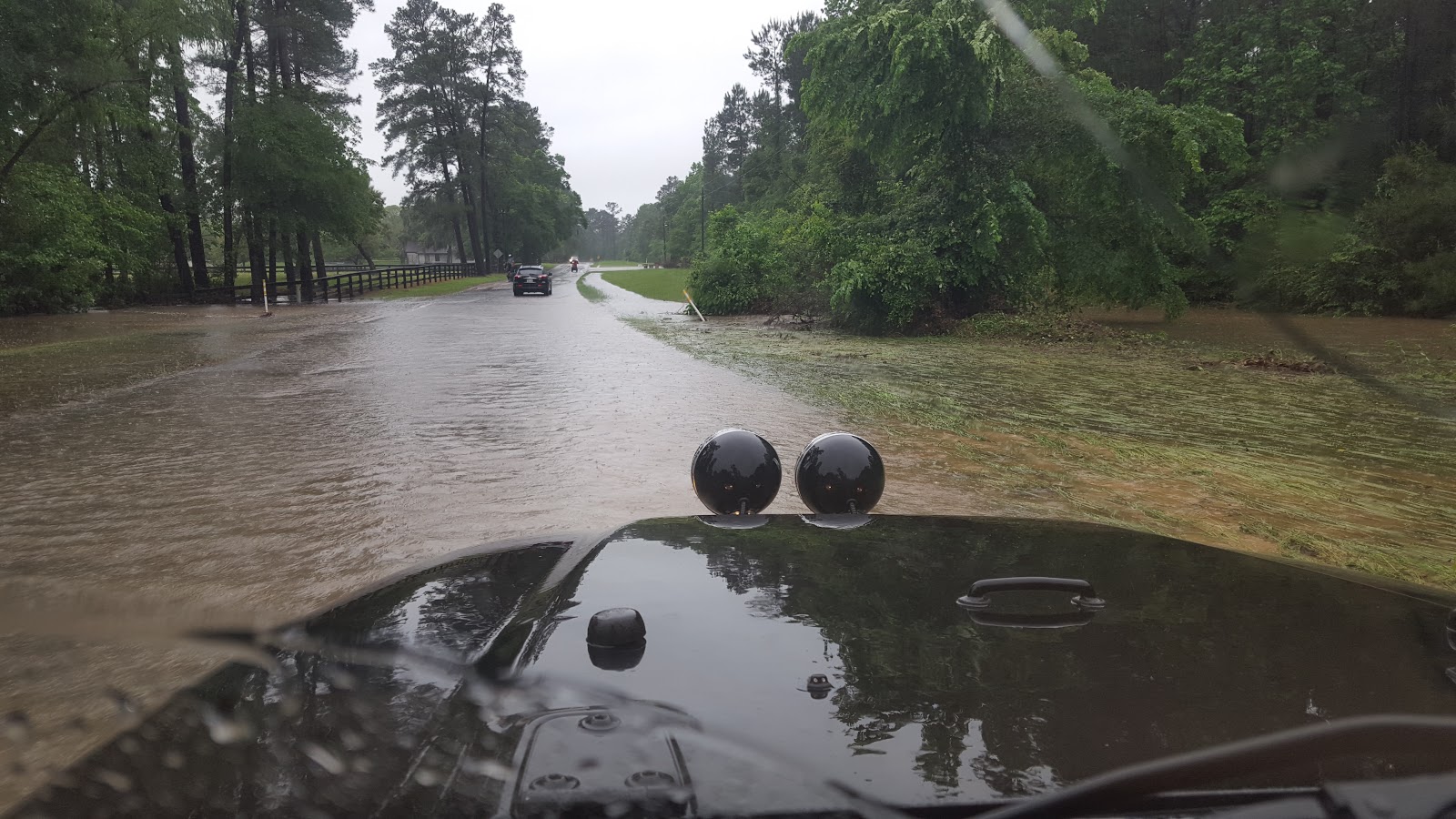
We endured the flooding, losing Pam's car about 100 yards (~ 100 m) from the safety of our neighborhood's gate.  It stalled in high water, and I got out of the car, waded to the gate, ran about a quarter of a mile (400 m) to get my Jeep, then drove back to retrieve Pam, my mom, and Mom's luggage (we were on our way back from picking her up at the airport).  All of this occurred about 1 AM.  We are all safe and well.  The house had no flooding, and our rain runoff pathed as we had hoped.  We were also blessed in that we lost no trees, at least none in the immediate perimeter of the house.

Just for an example of scale, the 20 inches (50 cm) of rain which fell on our five-acre (two-hectare) property can be expressed as 2,715,439 gallons (10,279,055 liters) of water.

Here is a video recorded two days later, after the torrential pouring had stopped (video link):


The entire drainage ditch was widened at least 50% by the fast moving waters.   The next day after the above video was recorded, we had heavy rains again (video link):


We now need to have a new hardscape plan to prevent further erosion of our drainage ditch, which will include four-inch (10 cm) thick flagstone and bullrock.  It might include the building of a retaining wall where the ditch bends around the front of the house and heads downhill.

Here are additional pictures from this "Texas Flood":

Pam's car, the next morning.  The water receded considerably, as the the night
before the water was up to the bottom of her headlights.

We had gotten through the worst part when the car died.  This is along the
drainage creek path -- the creek which actually (and ironically) runs along the
rear border of our property.  It had overflowed its banks and was over my
ankle-bone as I took this picture.  It was knee-high hours earlier when we
stranded the car.

I drove through the ankle-deep water in the Jeep to take this picture of the
water and Pam's car.  The Jeep, with no modifications, can traverse 30 inches
 (~80cm) of water.  Had we known it was going to flood like this, I would have
put the rear seat in the Jeep and we would have used it to go to the airport.

This is taken from our street, which is about 10 feet (3 m) above the
foundation of the house.  The leaning oak after which we have named our
home can be seen in the foreground. 

The water drains from the large pipeline right-of-way which runs across the
front of our property through the trees at this point, which is to the left
of the property in the picture above, in front of the two-car garage (the
structure on the far left).  Here we will add flagstone to slow the water's
velocity before it hits our drainage ditch.

This is the bend to which I referred above, and it is at least 100% wider than
it was the day before the rains.  I will probably build a retaining wall, as another
heavy rain could cause the tree to fall.

This is the way it is supposed to work, with the water draining around the
foundation pad and running downhill to the creek.  This part worked well.

Our deer returned to feed again, and paused long enough for me to take his
picture before entering the thicket.

The wildflowers remind us that there is life after the storm.  These have seen many, and continue to return and bless us
with their beauty.  These grow in the front of our property.

Wednesday, April 6, 2016

Terra, Flora, and a Salad (but not necessarily in that order)

The lawn continues to thicken in places, and in other places, it is trying to take hold.  Leveling is still a challenge, and over-seeding is still taking place.  Raking rocks has become the "dread-but-must-do" task, and the simple pleasure of mowing yet abides.

Low angles are good for viewing many of my lawn areas now, because it is the only way it looks like we have real turf.  Don't get me wrong, it is coming along, but not fast enough for me.  It is coming along at the right rate, mind you, I just want to see quicker results.  That's why pictures in time-lapse are good; they remind me it is all progressing as expected.

I still have some low spots in the front which I need to level in order to improve drainage.  The last major leveling effort was effective, but I knew it would need to be tweaked.  I watered the lawn until it was soaked and could see the low areas in need of filling.  I need to remember to fluff the existing grass through the fill-soil so that it does not get smothered.

I rake the flanks of the property for rocks now, using my three-foot (0.9 m) landscaping rake.  Rocks occupy soil in a manner such they grass cannot grow it.  Rocks facilitate erosion scarps.  Rocks retain heat and dry the soil around them.  Rocks and grass do not play well together.  All along both sides of our 150-foot+ driveway, I have rocks seeping through from the days of construction.  With every rain there is a new rock reveal.  The only effective means of removing them is raking with the landscape rack.  I have tried others, but the landscape rake is the most efficient.  I will be raking well into the month of May.

The landscaped plants are in bloom, or very near to blooming!  The native flora is coming along well, also, with a few surprises (next blog).  I have pictures from African Iris, Red Yucca, and our Dogwood trees on this post.  We have lost about half of our prostrate rosemary, and our landscaper will replace it.  We do not know what problem the plants experienced.

Mowing is still the easiest and most satisfying aspect of my lawn care -- at this point.  I do the raking, edging, weed-whacking, trail maintenance, debris-blowing, adjusting sprinklers and their heads, and mowing.  Mowing feels like a reward after I have done the other stuff.

And I did not forget about the salad (see below)...

Enjoy the pictures:

One of my trouble areas in the front, still holding water hours after 16 minutes
of irrigation.  This needs to be resolved by filling and leveling.

Same area, different perspective using the sun to illuminate the standing
water.  When filling and leveling, I must take care that I do not damage the
existing grass.

Surprise!  This is a new project: growing native grasses in four-inch (10 cm)
pots.  I have Pink Muhly, Mexican Feathergrass, Little Bluestem, Blue Grama,
and Texoka Buffalograss.  I want to start them and then place them in different
areas between the house and the "wild" areas.

Here is a picture of the landscaping in the front of the house.  There is still
more to add, but in general, what is here is growing well.

The Red Yucca is coming along beautifully.

Our African Iris flowers are blooming in greater numbers now.

When will the Dogwoods bloom?  Can we be any closer?  The warm temperatures
and sunny days which loom ahead could pop the blossoms!

A Leaning Oak salad -- a meal unto itself.  I got into making "meal salads"
while I was in France, but this is the first one I have made at Leaning Oak.
It contains a "spring blend" of greens, walnuts, pine nuts, green olives,
tomato, carrots, dried cranberries, Italian salami and coppa, Serrano ham,
and topped with O2B2: Olive Oil , Balsamic Blanc (White Balsamic
Vinegar), and a dash of sea salt.  Enjoyed on the lanai.


Monday, March 21, 2016

Landscaping, Three Weeks Later...

I could not believe it had been three weeks since I posted!  What is wrong with me?  Oh yeah, I've been busy with nurturing the landscaping, among other things.

I looked at my American Express (AX) bill from the last month, which includes the last three weeks.  To be sure, Home Depot, Lowe's, and Tractor Supply Company have all benefitted from the landscaping effort at Leaning Oak.  Tools, hoses and other related kit, topsoil, and a new mower all put a sizeable ding in the AX bill.  I will say; however, that the new mower was among the smallest items purchased.  I originally thought I would a big Toro Zero Turn Radius (ZTR) mower for this property, with all the trees and other odd challenges it presents.  The one I wanted is here, but upon examining the places where I actually have grass, I realized the ZTR was overkill.  I got this mower, instead.  Yes, an old-style, reel-cut mower.  

A reel-cut mower acts like scissors when cutting the grass instead of a machete, as rotary mowers do.  I can cut the entire lawn in less than an hour without extra effort.  My mower came with a grass catcher, but I have yet to use it.  I have been mowing very frequently to encourage grass density development -- this is what golf course managers do to insure a tight turf on golf courses, and it works the same for any turfgrass.  As our lawn areas have been seeded, turf density must be stimulated by mowing.  The reel-cut mower I have can cut from 1-inch (2.54 cm) to 3-inches (7.62 cm).  I was cutting some areas almost daily at 1 1/8-inch (2.86 cm).  Because of the scissors-like cut, where the grass blades are cut between a blade's sharp edge and the bedding knife, very small cuts can be achieved.

Side note: I had a self-propelled powered seven-blade reel-cut mower, very similar to the ones used on putting greens at golf courses when we lived in Oklahoma 25 years ago.  Because of the grass type and the mower, it was easily the most beautiful lawn I ever had, and yes, it was almost like a putting green.

The pictures today show some progress on our turf development, with pictures contrasting where we are now versus where we were three weeks ago.  We are still have a long way from having a lush lawn (in the manicured areas immediately adjacent to the house, the rest is still being left wild, but more on that in a near-future post), but we are getting there.  The grass which you see is still the cool weather perennial ryegrass, as the temperatures are not yet warm enough for the bermudagrass to emerge.

Here are the pictures, beginning with the "perspective" shot taken yesterday:

Taken yesterday, late afternoon...

Taken three weeks ago...

Taken yesterday

Three weeks ago...

Yesterday

Three weeks ago...

Yesterday.

The area in front of the two-car garage looking toward the street.  This area
did not receive the hydro-mulching (we ran out) and was seeded by hand.  It
also holds water (it does not always drain well), and getting the seed to
establish has been a challenge.

The same area, looking toward the two-car garage shows the gravel trim (to
keep cars off the grass) and the dogwood trees, which are now in leaf.  Blooms
are coming soon.

Yesterday, taken around mid-day, another perspective on the house and lawn development.